Go Scheduled Task Monitoring Guide
Go is popular for backend services with scheduled tasks. A crashed binary exits without notice, a hung process stays stuck forever. Here's how to monitor them.

Go Scheduled Task Monitoring Guide
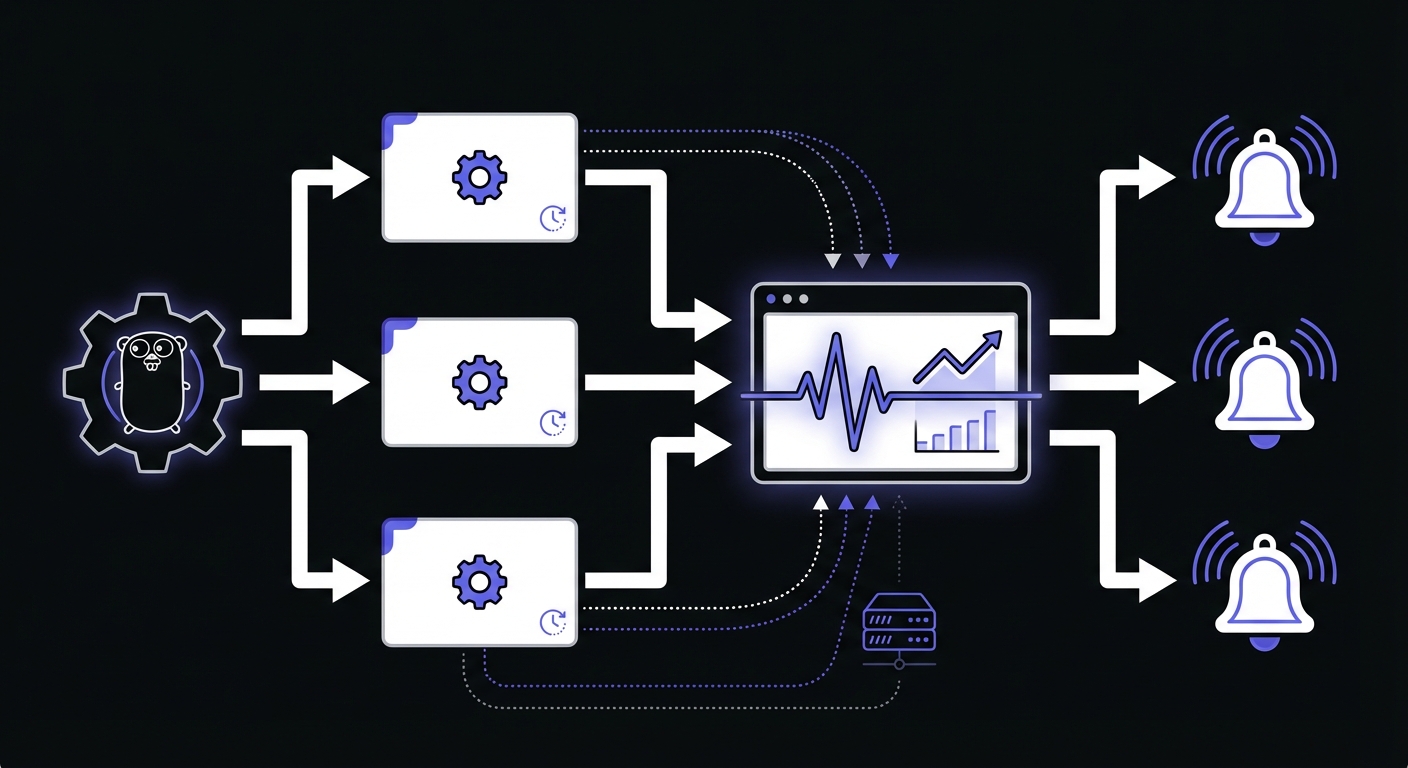
Go is increasingly popular for building backend services and command-line tools, many of which rely on scheduled tasks. Whether you run Go binaries via system cron or use libraries like robfig/cron for in-process scheduling, these jobs share a common problem: they fail silently. A crashed binary exits without notice, and a hung process stays stuck forever.
This guide covers monitoring patterns for Go scheduled tasks, from simple cron scripts to sophisticated job schedulers. For foundational concepts, check out our complete guide to cron job monitoring.
Go Scheduling Options
Go applications handle scheduled tasks in several ways.
System Cron with Go Binaries
The simplest approach: compile a Go program and schedule it with system cron. The binary runs, does its work, and exits.
# crontab
0 0 * * * /usr/local/bin/daily-report
robfig/cron Library
The most popular Go scheduling library. Jobs run within your Go process on a cron schedule.
import "github.com/robfig/cron/v3"

c := cron.New()
c.AddFunc("0 0 * * *", dailyJob)
c.Start()
go-co-op/gocron
A newer library with a fluent API and built-in monitoring support. gocron v2 (6.9k GitHub stars) includes a SchedulerMonitor interface for Prometheus integration and a companion web dashboard called gocron-ui for real-time job visualization.
import "github.com/go-co-op/gocron/v2"

s, _ := gocron.NewScheduler()
s.NewJob(
    gocron.DailyJob(1, gocron.NewAtTimes(gocron.NewAtTime(0, 0, 0))),
    gocron.NewTask(dailyJob),
)
s.Start()
Built-in time.Ticker
For simple periodic tasks within a long-running application:
ticker := time.NewTicker(1 * time.Hour)
for range ticker.C {
    hourlyJob()
}
Monitoring System Cron Go Programs
Let's start with the most common pattern: a Go binary scheduled via system cron.

Basic monitored program:
package main

import (
    "fmt"
    "log"
    "net/http"
    "os"
    "time"
)

const monitorURL = "https://ping.example.com/abc123"

var client = &http.Client{
    Timeout: 10 * time.Second,
}

func ping(endpoint string) {
    url := monitorURL + endpoint
    resp, err := client.Get(url)
    if err != nil {
        log.Printf("Monitor ping failed: %v", err)
        return
    }
    defer resp.Body.Close()
}

func main() {
    // Signal start
    ping("/start")

    if err := processData(); err != nil {
        // Signal failure
        ping("/fail")
        log.Fatal(err)
    }

    // Signal success
    ping("")
    fmt.Println("Job completed successfully")
}

func processData() error {
    // Your job logic here
    fmt.Println("Processing data...")
    return nil
}
Key points:
- Create a shared HTTP client with a timeout
- Signal start before any processing
- Signal failure before calling
log.Fatal(which exits immediately) - Signal success only after all work completes
Monitoring robfig/cron Jobs
For in-process scheduling with robfig/cron, wrap your job functions with monitoring.
package main

import (
    "log"
    "net/http"
    "os"
    "time"

    "github.com/robfig/cron/v3"
)

var client = &http.Client{
    Timeout: 10 * time.Second,
}

var monitors = map[string]string{
    "daily-report":  os.Getenv("MONITOR_DAILY_REPORT"),
    "hourly-sync":   os.Getenv("MONITOR_HOURLY_SYNC"),
    "cleanup":       os.Getenv("MONITOR_CLEANUP"),
}

func ping(monitorURL, endpoint string) {
    if monitorURL == "" {
        return
    }

    resp, err := client.Get(monitorURL + endpoint)
    if err != nil {
        log.Printf("Monitor ping failed: %v", err)
        return
    }
    defer resp.Body.Close()
}

func monitoredJob(name string, job func() error) func() {
    return func() {
        url := monitors[name]
        ping(url, "/start")

        if err := job(); err != nil {
            log.Printf("Job %s failed: %v", name, err)
            ping(url, "/fail")
            return
        }

        ping(url, "")
    }
}

func dailyReport() error {
    log.Println("Generating daily report...")
    // Report generation logic
    return nil
}

func hourlySync() error {
    log.Println("Syncing data...")
    // Sync logic
    return nil
}

func cleanup() error {
    log.Println("Running cleanup...")
    // Cleanup logic
    return nil
}

func main() {
    c := cron.New()

    c.AddFunc("0 0 * * *", monitoredJob("daily-report", dailyReport))
    c.AddFunc("0 * * * *", monitoredJob("hourly-sync", hourlySync))
    c.AddFunc("0 3 * * *", monitoredJob("cleanup", cleanup))

    c.Start()

    // Block forever (or until signal)
    select {}
}
Creating a Reusable Wrapper
For cleaner code, create a reusable monitoring wrapper.
package monitor

import (
    "fmt"
    "net/http"
    "net/url"
    "os"
    "time"
)

// Monitor handles job monitoring pings
type Monitor struct {
    BaseURL string
    Client  *http.Client
}

// New creates a Monitor from an environment variable
func New(envVar string) *Monitor {
    return &Monitor{
        BaseURL: os.Getenv(envVar),
        Client: &http.Client{
            Timeout: 10 * time.Second,
        },
    }
}

// NewWithURL creates a Monitor with a direct URL
func NewWithURL(baseURL string) *Monitor {
    return &Monitor{
        BaseURL: baseURL,
        Client: &http.Client{
            Timeout: 10 * time.Second,
        },
    }
}

// Ping sends a signal to the monitor
func (m *Monitor) Ping(endpoint string) {
    if m.BaseURL == "" {
        return
    }

    resp, err := m.Client.Get(m.BaseURL + endpoint)
    if err != nil {
        return // Silently ignore monitoring failures
    }
    defer resp.Body.Close()
}

// PingWithError sends a failure signal with error details
func (m *Monitor) PingWithError(err error) {
    if m.BaseURL == "" {
        return
    }

    u, parseErr := url.Parse(m.BaseURL + "/fail")
    if parseErr != nil {
        return
    }

    q := u.Query()
    if err != nil {
        msg := err.Error()
        if len(msg) > 100 {
            msg = msg[:100]
        }
        q.Set("error", msg)
    }
    u.RawQuery = q.Encode()

    resp, httpErr := m.Client.Get(u.String())
    if httpErr != nil {
        return
    }
    defer resp.Body.Close()
}

// Start signals job start
func (m *Monitor) Start() {
    m.Ping("/start")
}

// Success signals successful completion
func (m *Monitor) Success() {
    m.Ping("")
}

// Fail signals job failure
func (m *Monitor) Fail(err error) {
    m.PingWithError(err)
}

// Wrap creates a monitored version of a function
func (m *Monitor) Wrap(fn func() error) func() {
    return func() {
        m.Start()

        if err := fn(); err != nil {
            m.Fail(err)
            return
        }

        m.Success()
    }
}

// Run executes a function with monitoring
func (m *Monitor) Run(fn func() error) error {
    m.Start()

    err := fn()
    if err != nil {
        m.Fail(err)
        return err
    }

    m.Success()
    return nil
}
Using the wrapper:
package main

import (
    "log"

    "github.com/robfig/cron/v3"
    "myapp/monitor"
)

func main() {
    reportMonitor := monitor.New("MONITOR_DAILY_REPORT")
    syncMonitor := monitor.New("MONITOR_HOURLY_SYNC")

    c := cron.New()

    c.AddFunc("0 0 * * *", reportMonitor.Wrap(dailyReport))
    c.AddFunc("0 * * * *", syncMonitor.Wrap(hourlySync))

    c.Start()
    select {}
}

func dailyReport() error {
    log.Println("Generating report...")
    return nil
}

func hourlySync() error {
    log.Println("Syncing data...")
    return nil
}
For standalone binaries:
package main

import (
    "fmt"
    "log"
    "os"

    "myapp/monitor"
)

func main() {
    m := monitor.New("MONITOR_DAILY_JOB")

    err := m.Run(func() error {
        return processData()
    })

    if err != nil {
        log.Fatal(err)
    }

    fmt.Println("Done!")
}

func processData() error {
    // Your job logic
    return nil
}
HTTP Client Best Practices
Go's default HTTP client has no timeout, which can cause jobs to hang. Always configure a client properly.
package main

import (
    "log"
    "net/http"
    "time"
)

// Create a client with sensible defaults
var client = &http.Client{
    Timeout: 10 * time.Second,
    Transport: &http.Transport{
        MaxIdleConns:        10,
        IdleConnTimeout:     30 * time.Second,
        DisableCompression:  true,
    },
}

func ping(url string) {
    resp, err := client.Get(url)
    if err != nil {
        log.Printf("Monitor ping failed: %v", err)
        return
    }
    defer resp.Body.Close()

    // Optionally check status code
    if resp.StatusCode >= 400 {
        log.Printf("Monitor returned status %d", resp.StatusCode)
    }
}
Passing Job Metadata
Send additional context with your pings for better observability.
package main

import (
    "fmt"
    "net/http"
    "net/url"
    "time"
)

var client = &http.Client{Timeout: 10 * time.Second}

func pingWithData(baseURL string, data map[string]string) {
    u, err := url.Parse(baseURL)
    if err != nil {
        return
    }

    q := u.Query()
    for k, v := range data {
        q.Set(k, v)
    }
    u.RawQuery = q.Encode()

    resp, err := client.Get(u.String())
    if err != nil {
        return
    }
    defer resp.Body.Close()
}

func main() {
    monitorURL := "https://ping.example.com/abc123"

    // Signal start
    pingWithData(monitorURL+"/start", nil)

    // Do work
    processed, err := processRecords()
    if err != nil {
        pingWithData(monitorURL+"/fail", map[string]string{
            "error": err.Error(),
        })
        return
    }

    // Signal success with metadata
    pingWithData(monitorURL, map[string]string{
        "processed": fmt.Sprintf("%d", processed),
        "duration":  "45s",
    })
}

func processRecords() (int, error) {
    // Process logic
    return 150, nil
}
Prometheus Metrics with gocron
For applications already using Prometheus, gocron v2 provides a SchedulerMonitor interface that exposes job execution metrics directly to your metrics stack.
package main

import (
    "time"

    "github.com/go-co-op/gocron/v2"
    "github.com/prometheus/client_golang/prometheus"
    "github.com/prometheus/client_golang/prometheus/promauto"
)

type PrometheusMonitor struct {
    jobsCompleted   prometheus.Counter
    jobsFailed      prometheus.Counter
    executionTime   prometheus.Histogram
    schedulingDelay prometheus.Histogram
}

func NewPrometheusMonitor() *PrometheusMonitor {
    return &PrometheusMonitor{
        jobsCompleted: promauto.NewCounter(prometheus.CounterOpts{
            Name: "cron_jobs_completed_total",
            Help: "Total number of successfully completed cron jobs",
        }),
        jobsFailed: promauto.NewCounter(prometheus.CounterOpts{
            Name: "cron_jobs_failed_total",
            Help: "Total number of failed cron jobs",
        }),
        executionTime: promauto.NewHistogram(prometheus.HistogramOpts{
            Name:    "cron_job_execution_seconds",
            Help:    "Time spent executing cron jobs",
            Buckets: []float64{0.1, 0.5, 1, 5, 10, 30, 60, 300},
        }),
        schedulingDelay: promauto.NewHistogram(prometheus.HistogramOpts{
            Name:    "cron_job_scheduling_delay_seconds",
            Help:    "Delay between scheduled and actual start time",
            Buckets: []float64{0.001, 0.01, 0.1, 1, 5},
        }),
    }
}

func (p *PrometheusMonitor) JobCompleted(job gocron.Job) {
    p.jobsCompleted.Inc()
}

func (p *PrometheusMonitor) JobFailed(job gocron.Job, err error) {
    p.jobsFailed.Inc()
}

func (p *PrometheusMonitor) JobExecutionTime(job gocron.Job, duration time.Duration) {
    p.executionTime.Observe(duration.Seconds())
}

func (p *PrometheusMonitor) JobSchedulingDelay(job gocron.Job, scheduled, actual time.Time) {
    p.schedulingDelay.Observe(actual.Sub(scheduled).Seconds())
}

// Implement remaining SchedulerMonitor methods...

func main() {
    monitor := NewPrometheusMonitor()

    s, _ := gocron.NewScheduler(
        gocron.WithSchedulerMonitor(monitor),
    )

    s.NewJob(
        gocron.DurationJob(5*time.Minute),
        gocron.NewTask(processData),
    )

    s.Start()
}
Key metrics to track:
| Metric | Purpose |
|---|---|
cron_jobs_completed_total | Track successful executions |
cron_jobs_failed_total | Alert on failure spikes |
cron_job_execution_seconds | Detect slow jobs before timeouts |
cron_job_scheduling_delay_seconds | Identify scheduler overload |
Error rate calculation: jobsFailed / (jobsCompleted + jobsFailed)
Retry with Exponential Backoff
Jobs that call external services benefit from retry logic. The cenkalti/backoff library provides exponential backoff with jitter to prevent thundering herd problems.
package main

import (
    "context"
    "errors"
    "log"
    "net/http"
    "time"

    "github.com/cenkalti/backoff/v4"
)

func fetchDataWithRetry(ctx context.Context, url string) ([]byte, error) {
    var result []byte

    operation := func() error {
        req, _ := http.NewRequestWithContext(ctx, "GET", url, nil)
        resp, err := http.DefaultClient.Do(req)
        if err != nil {
            return err // Retryable
        }
        defer resp.Body.Close()

        // Don't retry client errors (4xx)
        if resp.StatusCode >= 400 && resp.StatusCode < 500 {
            return backoff.Permanent(errors.New("client error"))
        }

        // Retry server errors (5xx)
        if resp.StatusCode >= 500 {
            return errors.New("server error")
        }

        // Read response...
        return nil
    }

    // Exponential backoff: 500ms, 1s, 2s, 4s... up to 30s max
    b := backoff.NewExponentialBackOff()
    b.MaxElapsedTime = 2 * time.Minute
    b.MaxInterval = 30 * time.Second

    err := backoff.Retry(operation, backoff.WithContext(b, ctx))
    return result, err
}

func monitoredJobWithRetry() error {
    ctx, cancel := context.WithTimeout(context.Background(), 5*time.Minute)
    defer cancel()

    _, err := fetchDataWithRetry(ctx, "https://api.example.com/data")
    if err != nil {
        log.Printf("Job failed after retries: %v", err)
        return err
    }

    return nil
}
Error categorization for retries:
| Error Type | Action | Examples |
|---|---|---|
| Network timeout | Retry with backoff | Connection refused, DNS failure |
| Server error (5xx) | Retry with backoff | 500, 502, 503, 504 |
| Rate limited (429) | Retry with longer delay | Too many requests |
| Client error (4xx) | Do not retry | 400, 401, 403, 404 |
| Permanent failure | Do not retry | Invalid credentials, missing resource |
Go-Specific Considerations
Graceful Shutdown Handling
Long-running schedulers should handle shutdown signals gracefully.
package main

import (
    "context"
    "log"
    "os"
    "os/signal"
    "syscall"
    "time"

    "github.com/robfig/cron/v3"
    "myapp/monitor"
)

func main() {
    c := cron.New()

    reportMonitor := monitor.New("MONITOR_DAILY_REPORT")
    c.AddFunc("0 0 * * *", reportMonitor.Wrap(dailyReport))

    c.Start()

    // Handle shutdown signals
    quit := make(chan os.Signal, 1)
    signal.Notify(quit, syscall.SIGINT, syscall.SIGTERM)
    <-quit

    log.Println("Shutting down...")

    // Stop accepting new jobs
    ctx := c.Stop()

    // Wait for running jobs to complete (with timeout)
    select {
    case <-ctx.Done():
        log.Println("All jobs completed")
    case <-time.After(30 * time.Second):
        log.Println("Timeout waiting for jobs")
    }
}

func dailyReport() error {
    // Report logic
    return nil
}
Context Cancellation
For jobs that support cancellation, use context.
package main

import (
    "context"
    "log"
    "net/http"
    "time"
)

type MonitoredJob struct {
    MonitorURL string
    Client     *http.Client
}

func (m *MonitoredJob) Run(ctx context.Context, fn func(context.Context) error) error {
    m.ping("/start")

    err := fn(ctx)

    if ctx.Err() != nil {
        // Job was cancelled
        m.ping("/fail?error=cancelled")
        return ctx.Err()
    }

    if err != nil {
        m.ping("/fail")
        return err
    }

    m.ping("")
    return nil
}

func (m *MonitoredJob) ping(endpoint string) {
    if m.MonitorURL == "" {
        return
    }
    ctx, cancel := context.WithTimeout(context.Background(), 5*time.Second)
    defer cancel()

    req, _ := http.NewRequestWithContext(ctx, "GET", m.MonitorURL+endpoint, nil)
    resp, err := m.Client.Do(req)
    if err != nil {
        log.Printf("Ping failed: %v", err)
        return
    }
    defer resp.Body.Close()
}
Concurrent Job Safety
When running multiple jobs concurrently, ensure your monitoring doesn't introduce race conditions.
package main

import (
    "sync"
    "time"

    "github.com/robfig/cron/v3"
    "myapp/monitor"
)

func main() {
    c := cron.New(cron.WithChain(
        cron.Recover(cron.DefaultLogger), // Recover from panics
    ))

    // Each job gets its own monitor instance
    // No shared state between jobs
    c.AddFunc("0 * * * *", func() {
        m := monitor.New("MONITOR_JOB_A")
        m.Run(jobA)
    })

    c.AddFunc("0 * * * *", func() {
        m := monitor.New("MONITOR_JOB_B")
        m.Run(jobB)
    })

    c.Start()
    select {}
}

func jobA() error { return nil }
func jobB() error { return nil }
Binary Deployment Considerations
Go compiles to static binaries, which simplifies deployment but requires different approaches than interpreted languages.
Build with version info:
package main

import (
    "fmt"
    "runtime"
)

var (
    version   = "dev"
    buildTime = "unknown"
)

func main() {
    fmt.Printf("Version: %s, Built: %s, Go: %s\n",
        version, buildTime, runtime.Version())
    // ... rest of main
}
Build command:
go build -ldflags "-X main.version=1.2.3 -X main.buildTime=$(date -u +%Y-%m-%dT%H:%M:%SZ)" -o daily-jobCrontab entry:
0 0 * * * MONITOR_URL=https://ping.example.com/abc123 /usr/local/bin/daily-jobComplete Example: Production-Ready Cron Service
Here's a complete example combining all best practices.
package main

import (
    "context"
    "fmt"
    "log"
    "net/http"
    "net/url"
    "os"
    "os/signal"
    "syscall"
    "time"

    "github.com/robfig/cron/v3"
)

// Monitor handles job monitoring
type Monitor struct {
    url    string
    client *http.Client
}

func NewMonitor(envVar string) *Monitor {
    return &Monitor{
        url: os.Getenv(envVar),
        client: &http.Client{
            Timeout: 10 * time.Second,
        },
    }
}

func (m *Monitor) ping(endpoint string, params map[string]string) {
    if m.url == "" {
        return
    }

    u, err := url.Parse(m.url + endpoint)
    if err != nil {
        return
    }

    if params != nil {
        q := u.Query()
        for k, v := range params {
            q.Set(k, v)
        }
        u.RawQuery = q.Encode()
    }

    resp, err := m.client.Get(u.String())
    if err != nil {
        log.Printf("Monitor ping failed: %v", err)
        return
    }
    defer resp.Body.Close()
}

func (m *Monitor) Wrap(fn func() error) func() {
    return func() {
        start := time.Now()
        m.ping("/start", nil)

        err := fn()
        duration := time.Since(start)

        if err != nil {
            errMsg := err.Error()
            if len(errMsg) > 100 {
                errMsg = errMsg[:100]
            }
            m.ping("/fail", map[string]string{
                "error":    errMsg,
                "duration": duration.String(),
            })
            log.Printf("Job failed after %v: %v", duration, err)
            return
        }

        m.ping("", map[string]string{
            "duration": duration.String(),
        })
        log.Printf("Job completed in %v", duration)
    }
}

func dailyReport() error {
    log.Println("Generating daily report...")
    time.Sleep(2 * time.Second) // Simulate work
    return nil
}

func hourlySync() error {
    log.Println("Syncing data...")
    time.Sleep(1 * time.Second) // Simulate work
    return nil
}

func main() {
    log.SetFlags(log.Ldate | log.Ltime | log.Lshortfile)
    log.Println("Starting scheduler...")

    c := cron.New(
        cron.WithLogger(cron.VerbosePrintfLogger(log.Default())),
        cron.WithChain(cron.Recover(cron.DefaultLogger)),
    )

    // Register jobs with monitoring
    reportMonitor := NewMonitor("MONITOR_DAILY_REPORT")
    syncMonitor := NewMonitor("MONITOR_HOURLY_SYNC")

    c.AddFunc("0 0 * * *", reportMonitor.Wrap(dailyReport))
    c.AddFunc("0 * * * *", syncMonitor.Wrap(hourlySync))

    c.Start()
    log.Println("Scheduler started")

    // Graceful shutdown
    quit := make(chan os.Signal, 1)
    signal.Notify(quit, syscall.SIGINT, syscall.SIGTERM)
    <-quit

    log.Println("Shutting down...")
    ctx := c.Stop()

    select {
    case <-ctx.Done():
        log.Println("All jobs completed")
    case <-time.After(30 * time.Second):
        log.Println("Shutdown timeout")
    }
}
Quick Reference
Go Scheduling Libraries Comparison
| Library | GitHub Stars | Best For | Monitoring Support |
|---|---|---|---|
| robfig/cron | 14k | Standard cron expressions | Job wrappers, logging |
| go-co-op/gocron | 6.9k | Fluent API, metrics | SchedulerMonitor, gocron-ui |
| time.Ticker | Built-in | Simple intervals | Manual implementation |
Monitoring Best Practices
| Practice | Recommendation |
|---|---|
| HTTP timeout | 10 seconds for pings |
| Ping rate | Max 6 per minute per monitor |
| Grace period | 10-20% longer than job interval |
| Error truncation | Limit to 100 characters |
| Retry attempts | 3-5 with exponential backoff |
Common Failure Modes
| Failure | Detection | Prevention |
|---|---|---|
| Silent crash | Missing heartbeat | Start/finish pings |
| Hung process | Duration exceeded | Context timeout + ping |
| Panic | No completion ping | cron.Recover() wrapper |
| Network timeout | Delayed ping | HTTP client timeout |
Conclusion
Go's simplicity and performance make it excellent for scheduled tasks, but the same traits that make Go binaries reliable also make failures invisible. A crashed binary exits silently; a hung goroutine blocks forever without complaint.
Adding monitoring to Go scheduled tasks is straightforward. Create an HTTP client with appropriate timeouts, signal when jobs start and complete, and handle errors explicitly. The reusable monitor pattern shown here works across standalone binaries and in-process schedulers.
Start with your critical jobs: those that process payments, sync important data, or generate reports. Once those are monitored, expand coverage to maintenance tasks. The few lines of monitoring code will save hours of debugging when jobs inevitably fail.
If you are evaluating monitoring tools for your Go applications, see our cron monitoring pricing comparison and best cron monitoring tools guides.
Ready to monitor your Go scheduled tasks? Cron Crew works with any Go scheduling approach. Create a monitor, set your environment variable, and add a few lines of code for complete visibility into your background jobs.