Cron Crew vs Better Stack: SMB Edition
Better Stack is building an ambitious unified observability platform. But for small teams that just need cron monitoring, it might be more than you need.
Cron Crew vs Better Stack: SMB Edition
Better Stack is building an ambitious unified observability platform with VC backing and aggressive growth. They offer uptime monitoring, heartbeat monitoring, log management, and incident management in a single package. It is an impressive platform with a lot of momentum.
But for small teams that just need cron job monitoring, Better Stack's platform approach might be more than you need and more than you want to pay for. This comparison examines when the full platform makes sense versus when a focused cron monitoring tool is the better choice. For a comprehensive overview of your options, see our guide to the best cron monitoring tools.
Quick Comparison
| Feature | Cron Crew | Better Stack |
|---|---|---|
| Primary focus | Cron monitoring | Full observability platform |
| Free heartbeats | 15 | 10 |
| Entry price | $15/mo | $29/mo per responder |
| Pricing model | Per-monitor, flat | Per-responder + usage |
| VC-funded | No | Yes ($28.6M) |
| Founded | Recent | 2021 |
Better Stack Overview
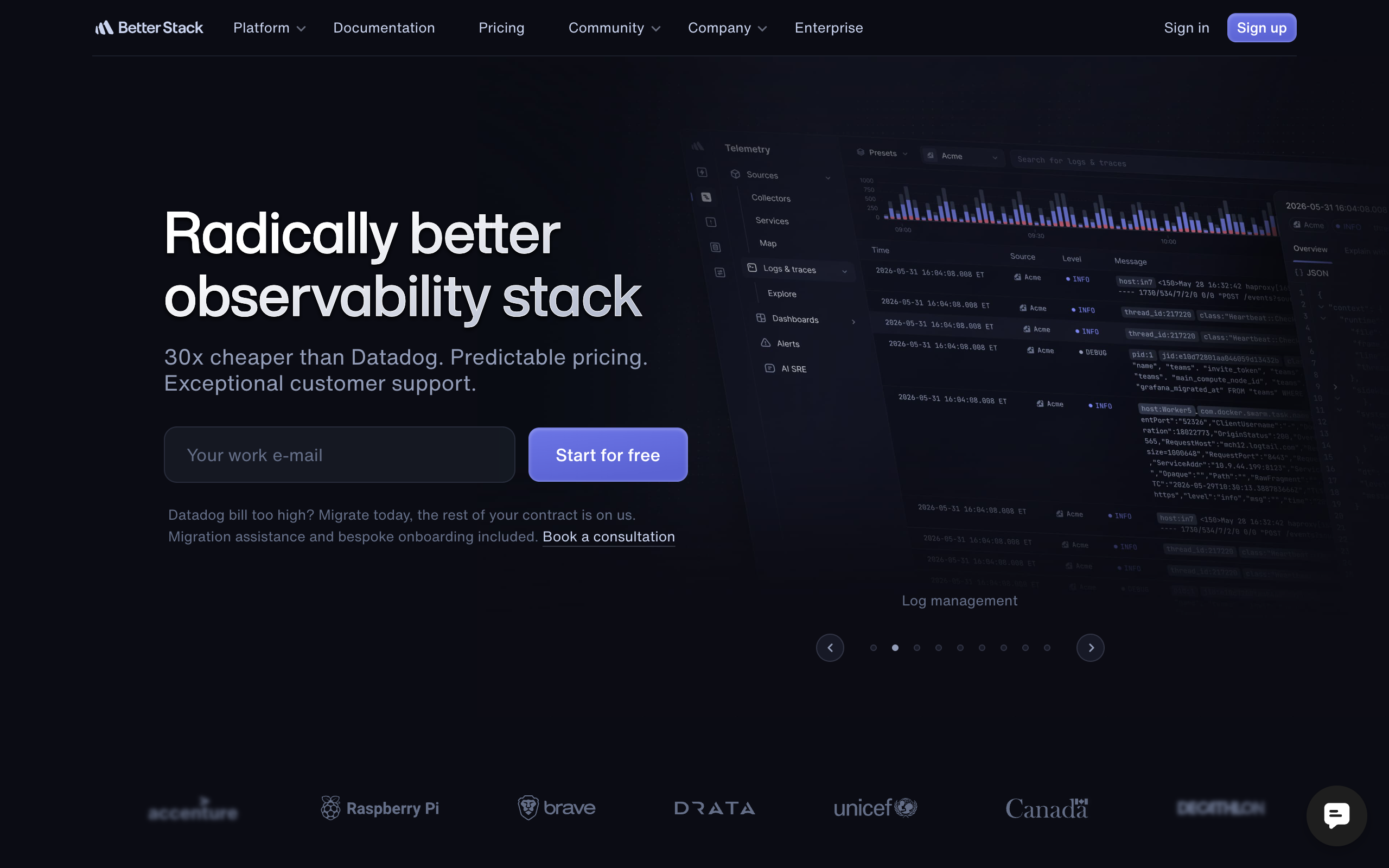
Better Stack (formerly known as Logtail) launched in 2021 out of Prague and has raised $28.6 million from investors including Creandum. They are building a unified observability platform that combines multiple monitoring products.
The Better Stack platform includes:
- Uptime monitoring: Website and API availability checking
- Heartbeat monitoring: Cron and scheduled job monitoring
- Log management: Centralized logging with search
- Incident management: On-call scheduling and alerting
- Status pages: Public status communication
Key strengths:
- Unified platform: One tool for multiple observability needs
- Modern design: Clean, well-designed interface
- Active development: Rapid feature development with VC backing
- Strong content marketing: Extensive documentation and educational content
- 200K+ developers: Growing user base
Considerations:
- Per-responder pricing adds up for teams
- May be paying for features you do not use
- Platform complexity versus focused tools
Cron Crew Overview
Cron Crew focuses specifically on cron job monitoring. Rather than building a platform, Cron Crew does one thing well.
Key characteristics:
- Single focus: Cron monitoring, not a platform
- Simple pricing: Pay for monitors, not responders or usage
- No platform lock-in: Use alongside your existing tools
- SMB-focused: Features and pricing for small teams
The Platform vs Point Solution Debate
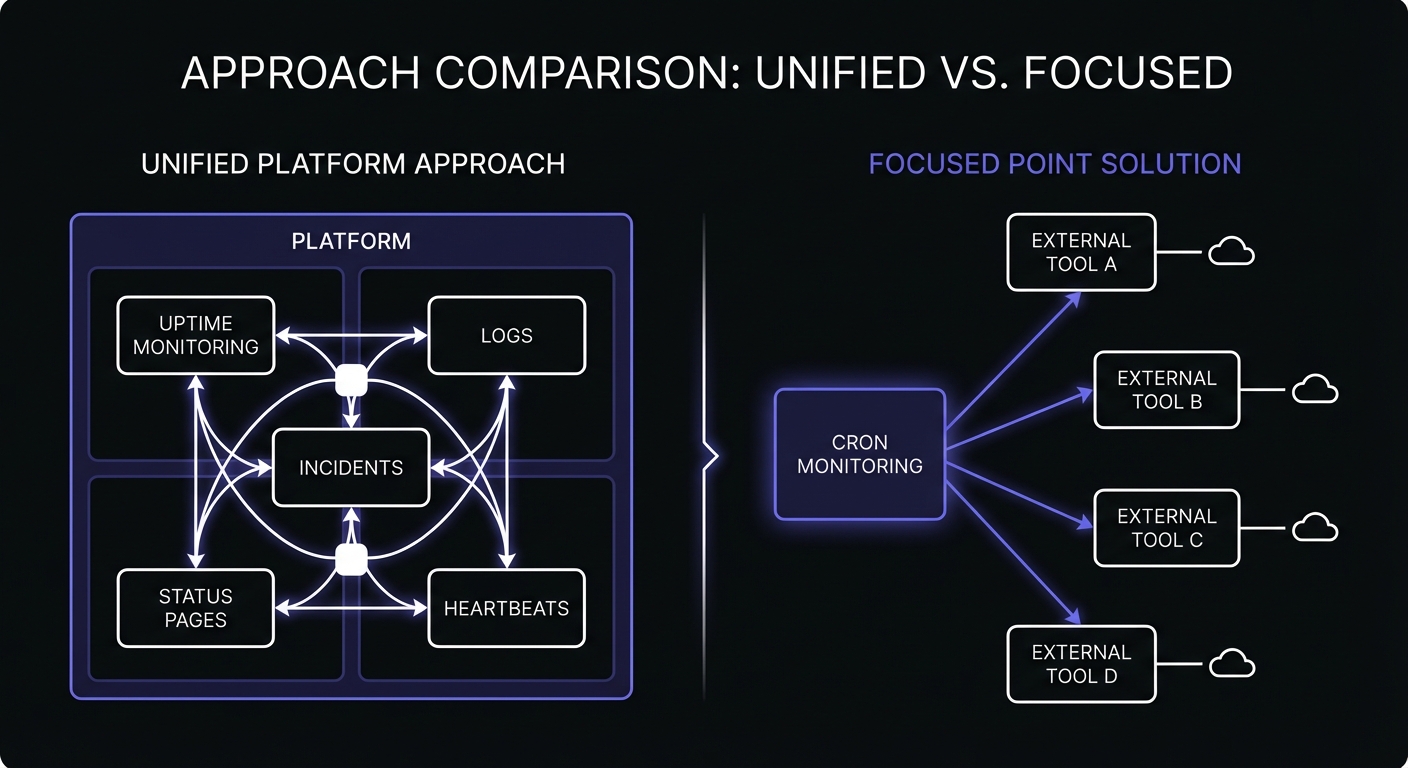
This comparison fundamentally comes down to a philosophical question: do you want a unified platform or best-of-breed tools for specific needs?
The Case for Unified Platforms (Better Stack)
Convenience: One login, one dashboard, one vendor relationship. Everything in one place reduces context switching.
Integrated features: Logs, uptime, heartbeats, and incidents all connected. Correlate events across systems easily.
Single bill: One invoice instead of multiple. Easier to budget and manage.
Unified support: One support team that understands your entire setup.
The Case for Point Solutions (Cron Crew)
Pay for what you use: Why pay for log management if you use Datadog? Why pay for uptime monitoring if you use Pingdom?
Best-of-breed: Specialized tools often do their specific job better than platform features.
No lock-in: If any tool disappoints, replace just that tool. Not your entire observability stack.
Lower complexity: A focused tool is easier to understand and manage.
Cost control: You control costs for each specific need independently.
The Tradeoff
Better Stack is compelling if you need multiple observability products and want them unified. Cron Crew is compelling if you just need cron monitoring and already have (or prefer separate) solutions for other needs.
Feature Comparison
Detailed Feature Matrix
| Feature | Cron Crew | Better Stack |
|---|---|---|
| Monitoring | ||
| Check frequency | 1-minute | 30-second |
| Grace period config | Yes | Yes |
| Cron expression support | Yes | Yes |
| Failure reporting endpoint | Yes | Yes (/fail) |
| Alerts | ||
| Yes | Yes | |
| Slack | Yes | Yes |
| Webhooks | Yes | Yes |
| SMS | No | Unlimited (paid) |
| Phone calls | No | Unlimited (paid) |
| Microsoft Teams | Yes | Yes |
| Team Features | ||
| Unlimited team members | Yes (all plans) | No (per-responder) |
| On-call scheduling | No | Yes |
| Escalation policies | No | Yes |
| Additional Features | ||
| Status pages | No | Yes ($12/mo each) |
| Log management | No | Yes (from $25/mo) |
| Uptime monitoring | No | Yes (included) |
| Screenshot capture | No | Yes |
| Playwright browser tests | No | Yes |
| Integrations | ||
| Third-party integrations | Core set | 100+ |
| Calendar sync | No | Google, Outlook |
Where Better Stack Wins
Platform breadth: Uptime, heartbeats, logs, incidents, and status pages in one product. If you need several of these, Better Stack is convenient.
Check frequency: 30-second checks versus 1-minute minimum. Useful for time-sensitive jobs.
Log correlation: Connect heartbeat failures with log entries. Better Stack captures screenshots of errors and provides second-by-second timelines for debugging.
Status pages: Built-in public status page functionality at status.yourdomain.com.
Incident management: On-call scheduling with Google Calendar and Outlook integration, escalation policies, and incident audit timelines.
Alert channels: Unlimited SMS and phone call alerts on paid plans.
Where Cron Crew Wins
Pricing simplicity: No per-responder fees. No usage-based surprises. Pick a tier and pay that price.
Focus: All development effort goes into cron monitoring. Not spread across five products.
Lower cost for cron monitoring: If you only need heartbeat monitoring, Cron Crew costs less.
No platform tax: You are not subsidizing features you do not use.
Team-friendly: Unlimited team members on all plans, including free.
Overlap
Both handle heartbeat monitoring basics:
- Cron expression support
- Alert notifications (email, Slack, webhooks)
- Dashboard visibility
- API access
- Grace period configuration
Pricing Deep Dive
Better Stack's pricing model deserves close examination because it differs significantly from traditional per-monitor pricing.
Better Stack Pricing
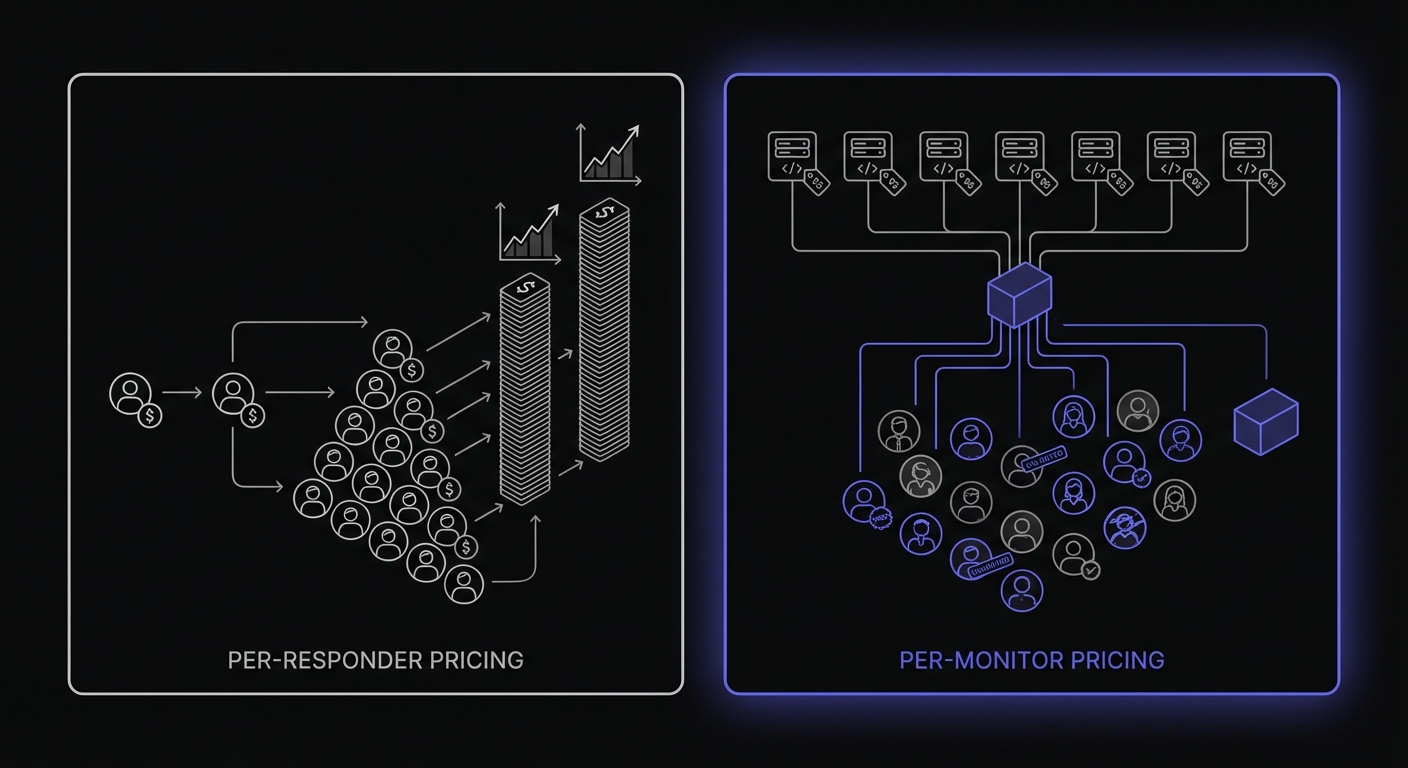
Better Stack charges per responder (team member who can receive alerts):
- Free: 10 heartbeats, 1 status page, email and Slack alerts
- Responder License: $34/mo (monthly) or $29/mo (annual) per responder
- Additional heartbeats: $20/mo for 10 (monthly) or $17/mo (annual)
- Additional monitors: $25/mo for 50 monitors
- Status pages: $12/mo each
Team of 3 example:
- 3 responders x $29 = $87/month (minimum, annual billing)
- Need more than 10 heartbeats? Add $17/mo per 10
- Does not include log management costs (starts at $25/mo for Nano tier)
- Usage-based charges may apply
Cron Crew Pricing
Cron Crew charges per monitor with no per-seat fees:
- Free: 15 monitors
- Starter ($15/mo): 50 monitors
- Pro ($29/mo): 100 monitors
Team of 3 example:
- Same team, same usage: $15/month
- Whole team included in the price
Cost Comparison
For a team of 5 with 30 cron jobs to monitor:
| Service | Monthly Cost | Annual Cost |
|---|---|---|
| Better Stack | $145+ | $1,740+ |
| Cron Crew | $15 | $180 |
The difference is significant: $1,560 annually for this example scenario. For a complete breakdown of pricing across the market, see our cron monitoring pricing comparison.
The Platform Tax
Better Stack's per-responder model makes sense for their platform vision. They are selling unified observability, and responders need access to all products.
But if you only need heartbeat monitoring, you are paying the responder fee for access to a platform you do not fully use. This is the "platform tax" that point solutions avoid.
Best Fit: Better Stack
Better Stack is the better choice when:
You need unified observability: If you need uptime monitoring, log management, incident management, AND cron monitoring, Better Stack provides real value.
You have budget for the platform: Enterprise or well-funded teams with allocated observability budgets can afford the per-responder model.
Consolidation is a priority: Reducing the number of vendors and tools has value for your organization.
You want everything integrated: Log correlation with heartbeat failures is genuinely useful for debugging.
You need status pages: Built-in status page functionality is convenient.
Best Fit: Cron Crew
Cron Crew is the better choice when:
You only need cron monitoring: Do not pay for a platform when you need one feature.
You already have observability tools: Using Datadog for logs? Pingdom for uptime? Add Cron Crew for cron monitoring without replacing your stack.
Budget matters: The per-responder model is expensive for small teams that need multiple people to receive alerts.
You prefer best-of-breed: Specialized tools for specific needs, connected via integrations.
You want predictable pricing: No usage surprises, no per-responder math.
Using Both Tools
A pragmatic approach exists for teams that want some Better Stack features without going all-in:
Use Better Stack for:
- Uptime monitoring (if that is your primary need)
- Log management (if you choose their logging product)
- Status pages (if you need public status communication)
Use Cron Crew for:
- Cron job monitoring
- Heartbeat monitoring for scheduled tasks
This best-of-breed approach lets you:
- Pay for Better Stack's value where it matters to you
- Use a focused, cost-effective tool for cron monitoring
- Avoid the full platform tax
Both tools support webhook integrations, so you can connect them to your existing alerting infrastructure.
The VC Factor
Better Stack's $28.6 million in funding is worth considering. VC-funded companies have different incentives than bootstrapped alternatives.
Potential benefits:
- Fast feature development
- Strong engineering team
- Long runway for growth
Potential considerations:
- Pressure to grow revenue (future pricing changes?)
- Platform may evolve in directions driven by growth metrics
- Possible acquisition or pivot in the future
Neither is inherently good or bad. It is context for understanding each company's trajectory.
Quick Decision Framework
Use this framework to quickly determine which tool fits your needs:
Choose Better Stack if:
- You need 3+ observability products (uptime, logs, incidents, cron)
- You have budget for per-responder pricing ($29+/responder/month)
- Unlimited SMS/phone alerts matter to you
- You want on-call scheduling and escalation policies
- Log correlation with job failures is valuable for debugging
Choose Cron Crew if:
- You primarily need cron job monitoring
- You have existing tools for logs, uptime, or incidents
- Budget is constrained or unpredictable
- Your team has 3+ people who need alert access
- You want simple, flat-rate pricing
Conclusion
Better Stack is building something ambitious. A unified observability platform has real appeal for teams that need multiple monitoring products and want them integrated.
But for small teams that need reliable cron monitoring without the platform overhead, Cron Crew offers a simpler, more affordable solution. You get focused functionality at a fraction of the cost, with predictable pricing that does not scale with team size.
If you need unified observability and have the budget, evaluate Better Stack. If you need cron monitoring and want to control costs, try Cron Crew's free tier. There is room in the market for both approaches.
Need help deciding? Our guide on how to choose cron monitoring can help you evaluate the right approach for your team.